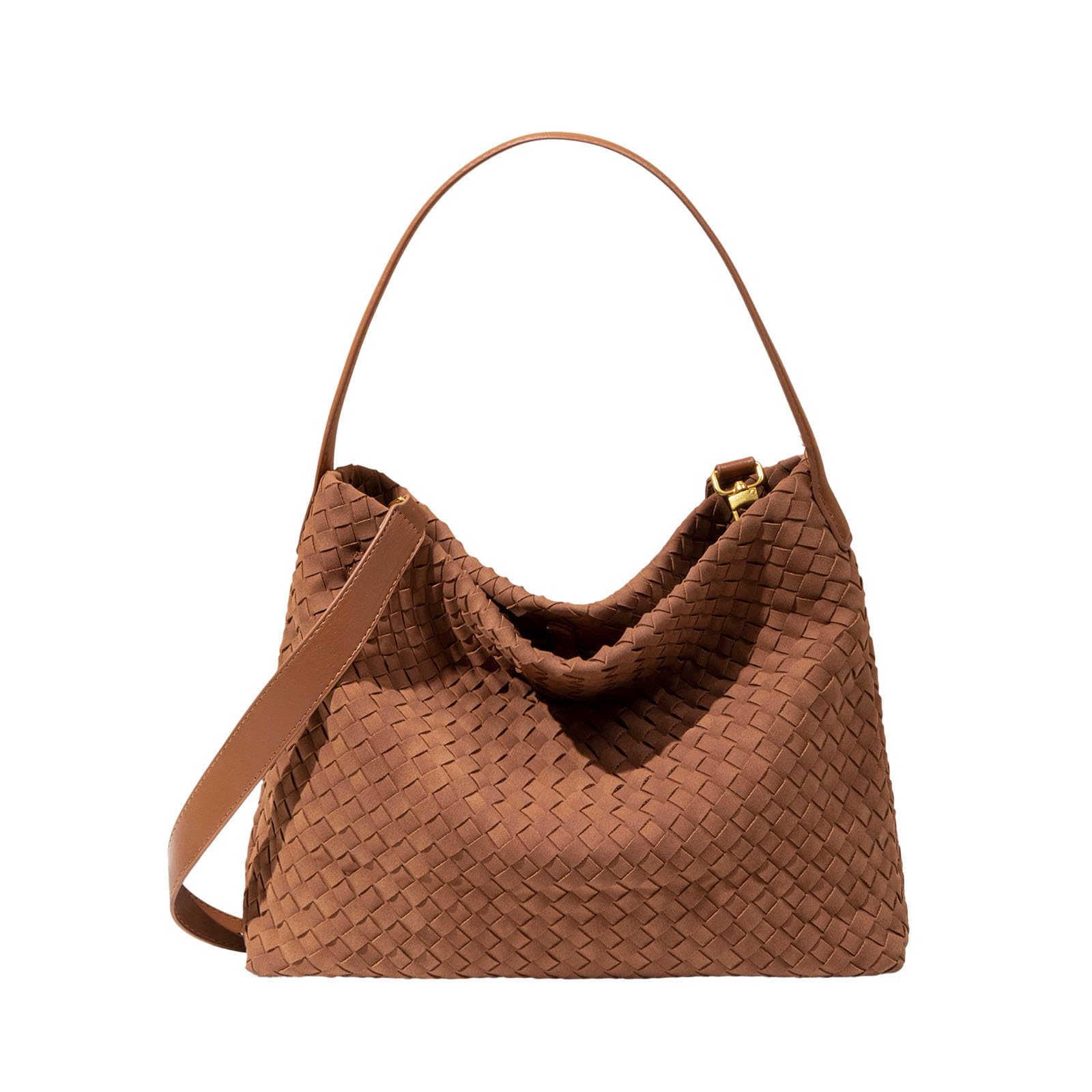
 It is a mathematical process disguised as craft.• — Women's Braided Leather Tote Bag Stylish Suede Hobo Shoulder Bag with Woven Details — $58.89
While it's hot.
The delicate gutta-percha surrounding the copper conductor required an outer layer of tightly braided jute, meticulously calibrated not for softness, but for its tensile strength and consistent void volume. One poorly tensioned strand, invisible to the average observer, could mean signal attenuation under deep-sea pressure, transforming a monumental $1.5 million investment into inert copper scrap. The fate of global communication briefly rested on the anonymous dexterity of Victorian textile workers producing non-fashionable, utterly vital cordage.
The utilization of precise interlinking methods extends far beyond simple aesthetic application, moving into realms where structural integrity is paramount. Consider the intricate process involved in generating triaxially braided carbon fiber preforms. This technique, demanding complex automated machinery, arranges high-modulus carbon filaments across three orthogonal axes, producing a near-net-shape structural component. The resulting composite exhibits exceptional damage tolerance and shear resistance, properties unattainable through traditional two-dimensional weaving or unidirectional layering. This braiding geometry, a sophisticated adaptation of an ancient technique, now forms critical load-bearing elements in aerospace structures—a testament to pattern reliability exceeding simple material strength.
The Ainu people of Hokkaido provide a divergent, yet equally specialized, example through the fabrication of *attus* fiber cloth. This material is not harvested cotton or common flax; it is derived from the inner bark of specific elm species. After extensive soaking and beating, the resulting fibers are meticulously braided into robust, lightweight garments and utility straps designed to withstand the region's harsh climate. The subtle, irregular sheen of the finished *attus* speaks to the seasonal variation in bark quality and the inherent patience required in its production, where the artisan’s understanding of organic chemistry and fiber tension determines the finished object's lifespan. The resulting fabric is uniquely cool in the summer and insulating in colder temperatures—a highly specific thermoregulatory outcome achieved through precise botanical preparation and manual interlacement.
The appreciation for a finely executed braid often hinges on understanding its intrinsic difficulty—the way discrete, flexible elements cooperate under tension to achieve rigidity. This is apparent even in the obscure application of fine metal wire braiding used in electromagnetic shielding within highly sensitive laboratory equipment. Here, the braid is not visible or tactile; its function is entirely electronic, designed to form a seamless Faraday cage around delicate signals. The minute, almost microscopic, helical angles must be perfectly consistent across hundreds of feet of cable length to prevent signal leakage or external interference. This highly engineered braid, lacking any traditional visual appeal, exists solely to enforce silence and integrity in a complex mechanical system.
Highlights:
• Jute braiding provided critical mechanical protection for 19th-century transatlantic telegraph cables, preventing deep-sea structural failure.• Triaxial braiding of carbon filaments creates high-modulus composite preforms, yielding superior structural components for aerospace engineering.
• *Attus* fiber, derived from specialized elm bark, is painstakingly braided by the Ainu for robust, temperature-regulating utilitarian garments.• Microscopic metal wire braiding ensures electromagnetic shielding integrity in sensitive electronic assemblies, enforcing signal isolation.
Point of view: [ Add To Cart ]
The fascination resides in the unexpected ubiquity of the braid—that such a fundamentally simple action, the systematic crossing of strands, generates such varied and essential complexities. It is a mathematical process disguised as craft. Consider the obscure, yet vital, phenomenon of fiber morphology influencing tensile output. In high-performance yachting, specialized Dyneema cordage, often densely braided, attains its remarkable strength-to-weight ratio not just from the polymer, but from the specific, non-circular cross-section of the individual filaments themselves, allowing for increased packing density within the braid structure. This subtle modification means the finished cordage can hold tonnage while remaining thin enough to run through exceptionally precise block and tackle systems. We look at a braided item and see only the pattern; we rarely grasp the complex physics of load dispersion happening at the micro-scale within that seemingly decorative overlap. The true luxury of such highly specific craftsmanship lies not in ostentation, but in the reliable performance derived from meticulous structural choreography.Get It On Amazon ::: (brought to you by Kiitn)
▷ While it's hot.
Women's Braided Leather Tote Bag Stylish Suede Hobo Shoulder Bag with Woven Details Price, $58.89 $ 58 . 89 See options
#Ad Our articles include affiliate links: If you buy something through a link, we may earn a commission 💕
[ Add To Cart ]


No comments:
Post a Comment